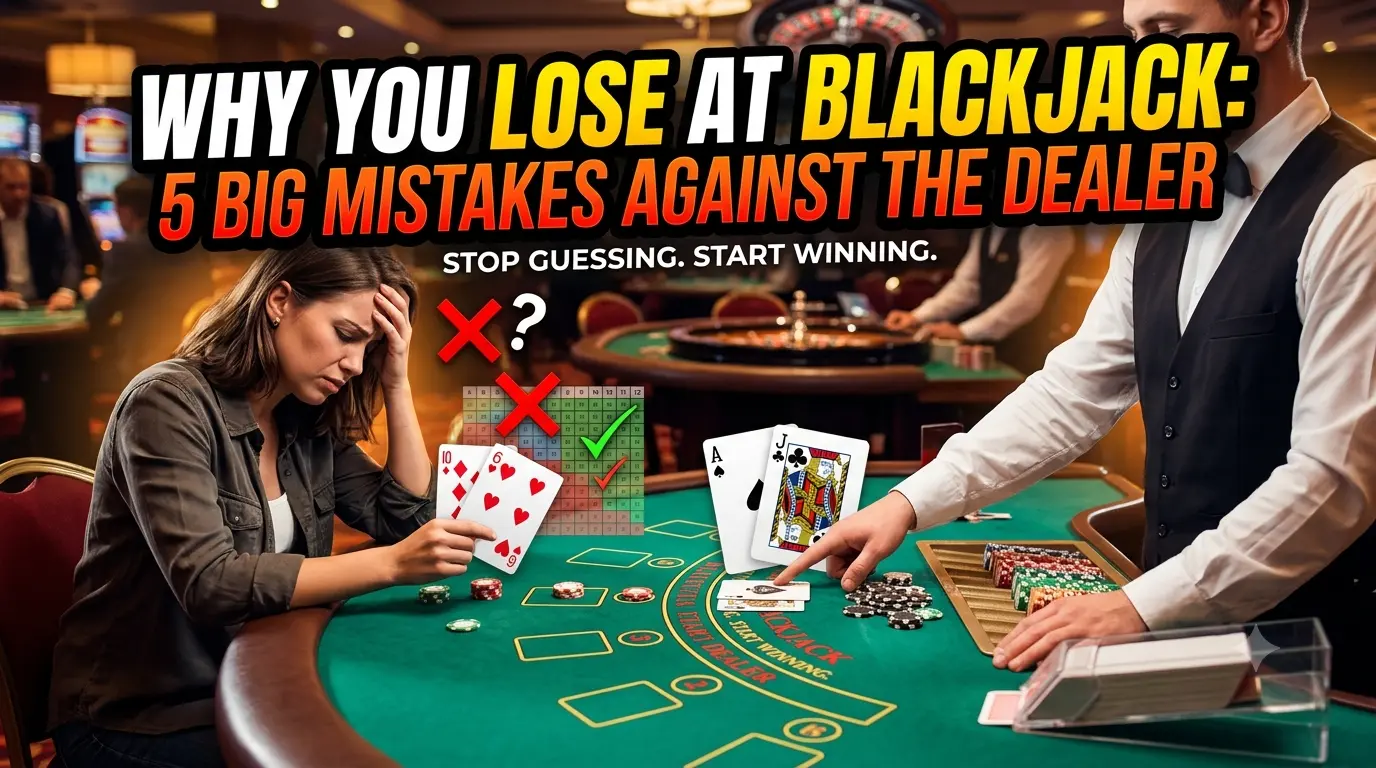
Do you always lose at blackjack? You are not alone, and you are not "unlucky." Blackjack is not a game of magic or bad energy at the table. Blackjack is a math problem. And once you learn how the math works, you will understand exactly why so many players walk away with empty pockets.
In this guide, we explain the real reasons behind every blackjack loss, in simple words. No confusing jargon. Just clear facts, real examples, and free tools you can use right now on our free blackjack game.
Blackjack Is Not Bad Luck. It Is Math.
Many players think blackjack is about "feeling" the table. They think a good dealer, a lucky seat, or a "hot" shoe of cards can change their fate. This is simply not true.
Blackjack is one of the most studied games in the world. Mathematicians have run billions of computer simulations to find the exact best move for every single hand. The game has clear rules, and those rules create a small, steady advantage for the casino. This advantage is called the house edge.
Once you understand the house edge and how it works, you stop blaming luck. You start making smarter choices. Let's look at the five biggest reasons players lose.
Reason 1: The "Bust Rule" Always Favors the Casino
This is the single biggest reason you lose at blackjack, and most players never even notice it.
In blackjack, you play first. If your cards go over 21, you "bust," and you lose your bet immediately. It does not matter what happens next. Even if the dealer also busts a few seconds later, you already lost. Your money is gone before the dealer even finishes their turn.
This one small rule creates what experts call the "bust advantage." It is the main reason the casino keeps a steady edge over time, even though the dealer follows fixed, simple rules with no choices to make.
| Blackjack Rule Type | Typical House Edge | What It Means for You |
|---|---|---|
| Standard 8-deck game, basic strategy, 3:2 payout | About 0.5% | Small, manageable edge if you play every hand correctly |
| No basic strategy (playing by "feel") | 2% to 5%+ | You lose money much faster than needed |
| 6:5 payout instead of 3:2 (see Reason 5) | +1.4% extra edge | You lose almost 3x faster on blackjack wins |
You can test this bust rule yourself for free. Try our strategy calculator and win-probability tool to see the exact odds behind every hand.
Reason 2: You Play With Your Feelings, Not With the Best Move
Blackjack is the only casino game where your decision changes the outcome. Every other casino game (like roulette or slots) is pure luck. But in blackjack, for every possible hand you can hold against every possible dealer card, there is one move that is mathematically correct. This is called basic strategy.
Basic strategy is not a guess. It comes from billions of simulated hands, calculated to give you the highest possible "expected value" (EV) — in simple words, the smallest possible loss (or the highest possible win) over time.
A Real Example: Hard 16 vs. Dealer's 7
Imagine you hold a hard 16 (for example, a 9 and a 7), and the dealer shows a 7. Most players feel scared and choose to stop ("stand"), because a 16 feels dangerously close to busting.
But the math says something different: in this situation, drawing another card actually loses you less money over time than standing does. It feels risky, but it is the smarter move. See the full breakdown on our hard 16 vs dealer 7 strategy page.
Another Example: Soft 18 vs. Dealer's 9
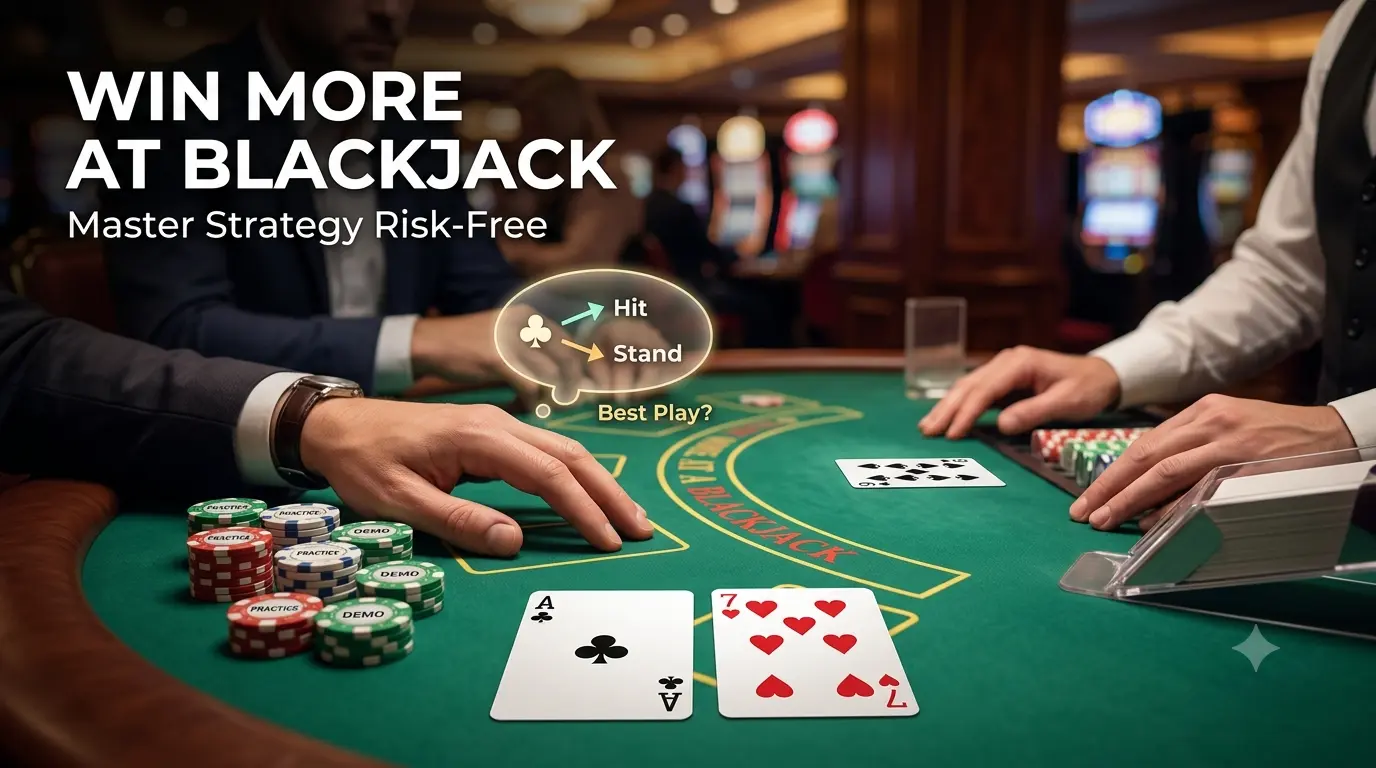
Here is another hand players get wrong all the time. You hold a soft 18 (an Ace and a 7), and the dealer shows a 9.
Many players stand here because 18 "feels safe." But basic strategy shows that hitting (or doubling, depending on the rules) is the stronger move against a strong dealer card like a 9. You can check this exact hand on our soft 18 vs dealer 9 page.
One More: Hard 13 vs. Dealer's 7
Against a strong dealer card, even a "safe-feeling" 13 usually needs another card. See the numbers yourself on our hard 13 vs dealer 7 page.
The pattern is always the same: feelings and facts do not match. The human brain is not built to calculate probability in a few seconds. That is exactly why basic strategy charts exist — to remove guesswork completely.
Reason 3: The Gambler's Fallacy — Cards Have No Memory
Have you ever lost five hands in a row and thought, "I'm due for a win now"? This feeling is extremely common, and it is completely wrong. It is known as the gambler's fallacy.
Modern card shuffles, whether physical or computer-based random number generators, have no memory. Every new hand is a completely separate event. The cards do not "remember" that you lost last time, and they do not "owe" you a win.
Physicist and author Leonard Mlodinow explains this idea clearly in his book on randomness. He points out that a good streak doesn't jinx you, and in the same way, a bad streak does not guarantee a win is coming next (Mlodinow, The Drunkard's Walk: How Randomness Rules Our Lives).
This mistaken belief is one of the most dangerous habits in gambling. It pushes players to raise their bets after a losing streak, hoping to "catch up." In reality, this only speeds up how fast they lose their money. If you want to read more about the science behind this, Wikipedia has a well-sourced overview of the gambler's fallacy.
Reason 4: Short-Term Luck Feels Real, But Big Numbers Always Win
You might have one great night at the table. You play by feeling, ignore the charts, and still walk away with more money than you started with. This happens, and it feels amazing. But it does not mean you "beat" blackjack.
Casinos are not worried about one lucky night. They rely on something called the law of large numbers. Over 100 hands, luck can go either way. But over 10,000 or 100,000 hands, luck evens out, and only the math remains. The small house edge slowly and steadily eats away at any player who is not using a proper strategy.
This is exactly the idea that made mathematician Edward O. Thorp famous. Before Thorp, most people believed a player could never gain any real edge in blackjack. Thorp used early computers to calculate the odds of every hand, and proved that with the right strategy and card counting, the long-term math could shift in the player's favor. His book, Beat the Dealer, changed the game forever and is still considered one of the most important gambling books ever written (source: Blackjack.org, Edward Thorp profile).
Thorp later used the same probability thinking on Wall Street. As he explained in one interview, the overlap of interest between gambling and the stock market is very high (source: mikeaponte.com). His point was simple: both are about managing risk with real numbers, not with hope.
Reason 5: The Sneaky 6-to-5 Payout Trap
This is a smaller detail, but it can quietly destroy your chances of winning.
When you get a natural blackjack (an Ace plus a 10-value card), traditional tables pay you 3 to 2. That means a $10 bet wins you $15.
But many modern tables, especially single-deck or fast-play tables, have quietly changed this payout to 6 to 5. That same $10 bet now only wins you $12.
| Blackjack Payout | Win on a $100 Bet | Effect on House Edge |
|---|---|---|
| 3 to 2 (traditional, fair) | $150 | Normal, small house edge (~0.5%) |
| 6 to 5 (modern, player-unfriendly) | $120 | House edge jumps by about 1.4% more |
This tiny-looking change massively increases how fast you lose money over time. Always check the payout rules on any table before you play, whether online or in person.
So... Why Do You Really Lose at Blackjack?
Let's bring it all together. You lose at blackjack because:
- You play first, so you can bust before the dealer even gets a turn (Reason 1)
- You follow your feelings instead of the mathematically correct move (Reason 2)
- You believe in "due" wins that the cards can never actually owe you (Reason 3)
- You judge the game by one short session, instead of the long-term math (Reason 4)
- You may be playing on a table with a worse payout rate than you realized (Reason 5)
In short: you lose because you play like a human, not like a calculator. Humans get tired, excited, scared, and hopeful. The math behind blackjack does not care about any of that. It is cold, clear, and always consistent.
How to Start Playing Smarter Today
The good news is simple: once you know the math, you can use it. Here is how to start:
- Learn basic strategy. Use our free strategy and win-probability calculator to check the correct move for any hand, instantly.
- Practice without risking real money. Play as many free hands as you like on our free blackjack game to build real habits before you ever play for money.
- Understand how fair the game really is. Curious about the shuffle and randomness behind online blackjack? Read our full blackjack algorithm and fairness breakdown.
- Know who is behind the numbers. Learn more about our mission and how we test every part of our game on our About Us page.
Frequently Asked Questions
Is blackjack really beatable, or is it always a loss in the end?
With perfect basic strategy, the house edge is very small, usually under 1%. This will not make you rich, but it means your losses stay slow and controlled instead of fast and painful.
Why do I lose even when I "know" the odds?
Most players know basic strategy exists, but do not actually follow it every single hand. Even skipping the correct move a few times per session adds up over hundreds of hands.
Does card counting still work today?
Card counting can shift the edge slightly in a skilled player's favor in specific live casino conditions, but it takes serious practice, and many casinos actively watch for it. For most players, mastering basic strategy gives the biggest, safest improvement.
What is the single fastest way to lose less money at blackjack?
Stop guessing. Use a basic strategy chart or calculator every single hand, and always check the blackjack payout rate (3:2, not 6:5) before you sit down.
Final Thought
Blackjack will always have a small edge for the casino — that is simply how the game survives as a business. But the size of that edge is almost entirely in your hands. Play with your feelings, and you hand the casino a bigger edge than it even needs. Play with the math, and you keep your losses as small as the game allows.
Ready to put this into practice? Try a free hand right now and see the difference smart decisions make.